
Finding evidence of a rodent in your home or business is unsettling enough. Finding the wrong treatment because you misidentified the pest is worse. Rats and mice are both common across New Zealand, but they behave differently, nest differently, and, critically, they require different control strategies. Getting the identification right from the start is what separates a resolved problem from a recurring one.
This guide covers every practical difference between a rat vs a mouse: what they look like, what their droppings reveal, where they nest, what they eat, and how a professional treats each one. If you have already spotted signs but are not sure which rodent you are dealing with, use our identification table below to confirm before taking action.
Physical Differences: How to Tell a Rat from a Mouse at a Glance
The most obvious difference between a rat and a mouse is size, but there are several other physical markers that help with confident identification.
Rats
The two species you are most likely to encounter in Australia and New Zealand are the Norway rat (Rattus norvegicus) and the roof rat (Rattus rattus or Black Rat). Both are considerably larger than mice. A fully grown rat typically measures 18–25 cm in body length with a thick, scaly tail that is shorter than its body. The snout is blunt and broad, the ears are small and set close to the head, and the feet are noticeably large. Adult rats weigh between 150 g and 500 g.

Mice
The house mouse (Mus musculus) is the most common mouse species in both countries. It is noticeably smaller, typically 6-9 cm in body length, with a slender tail that is longer than its body. Mice have pointed snouts, large ears relative to their head size, and small, delicate feet. An adult mouse rarely exceeds 30g.
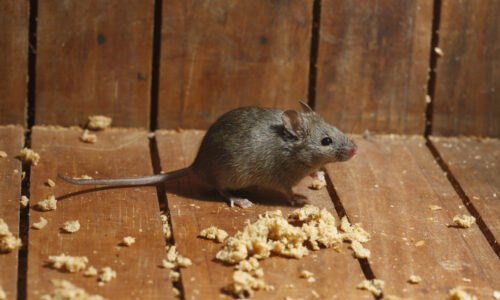
Rat vs Mouse Identification Table
| Feature | Rat | Mouse |
| Body length | 18-25 cm (plus tail) | 6-9 cm (plus tail) |
| Weight | 150-500 g | 12-30 g |
| Ears | Small, close-set | Large relative to head |
| Snout | Blunt and broad | Pointed |
| Tail | Shorter than body, thick | Longer than body, thin |
| Droppings | 10-20 mm, capsule-shaped | 3-6 mm, rice-grain sized |
| Nesting location | Burrows, wall cavities, roof | Roof voids, insulation, drawers |
| Diet preference | Meat, fish, cereals | Cereals, grains, chocolate |
| Activity | Cautious, neophobic | Curious, exploratory |
| Lifespan | Up to 18 months | Up to 12 months |
If you are still uncertain after consulting this table, the safest course of action is to book a professional inspection. Misidentification leads to misplaced baits, wrong trap types, and wasted time.
Rat Droppings vs Mouse Droppings: A Reliable Field Indicator
Droppings are often the first sign of a rodent infestation, and one of the most reliable ways to distinguish between the two species without ever seeing the animal itself.
Rat droppings
Rat droppings are substantially larger: typically 10-20 mm in length, with a blunt, capsule-like shape. Norway rat droppings tend to have a flat edge on one end. Fresh droppings are dark and moist; older ones are dry and grey. You will typically find them in clusters along walls, near food sources, or at the entrance to burrows.
Mouse droppings
Mouse droppings are much smaller: 3-6 mm in length, resembling a grain of rice with pointed ends. Fresh mouse droppings are dark brown and soft; they lighten and harden with age. Because mice produce up to 80 droppings per day (compared to roughly 40 for a rat), infestations can leave a wide scatter pattern rather than a concentrated cluster.
Health warning: Never handle rodent droppings without protection. Both rats and mice can carry Leptospirosis, Salmonella and Hantavirus. Wear disposable gloves and a P2 mask, and disinfect the area thoroughly before and after removal. If you are dealing with a large infestation, contact a professional for safe remediation.
Nesting Behaviour: Where Each Rodent Hides
Rats
Norway rats are ground-level nesters. They prefer to burrow, along fence lines, under slabs, in garden beds, or beneath decking. Roof rats, as the name suggests, are excellent climbers and will nest in roof voids, wall cavities, tree hollows, and dense ivy or bougainvillea. Look for: burrow entrances with smooth walls and freshly excavated soil, grease marks along walls and pipes, and gnaw marks on structural timbers or cabling.
Mice
Mice are opportunistic nesters that prefer warm, enclosed spaces close to a food source. Common nesting sites include roof voids, the backs of kitchen drawers, inside wall cavities, beneath floor coverings, and inside stored cardboard boxes. Look for: tiny gnaw marks on food packaging, greasy smear marks at low heights, and the distinctive musty odour that comes from a mouse nest.
Diet Differences: What Each Rodent Is After in Your Home
Diet preferences influence bait selection, a key reason why correct identification matters before any treatment begins.
Rats are omnivores with a preference for protein: meat, fish, pet food, eggs, and cereals. They are also neophobic, cautious around new objects in their territory, which means new bait stations may be ignored for several days before a rat investigates.
Mice are primarily grain and seed eaters, though they will readily take chocolate, peanut butter, and sweet foods. Unlike rats, mice are curious and exploratory, and will investigate new objects quickly, making them more responsive to snap traps placed near nesting sites.
Why Treatment Differs Between Rats and Mice
A treatment strategy designed for mice will not effectively control a rat infestation, and vice versa. Here is why the approach differs:
- Bait placement: Rat baits must be positioned along established travel routes and may need to sit undisturbed for several days. Mouse baits and traps are placed every 2-3 metres along active runs, closer to nesting sites.
- Trap sizing: A standard mouse snap trap cannot catch a rat. Rat-specific traps or tamper-resistant bait stations are required.
- Bait formulation: Rodenticides are formulated to account for body weight and feeding behaviour. A mouse-strength bait on a rat infestation may result in sub-lethal doses and bait shyness.
- Entry point sealing: Rats can squeeze through a 12 mm gap; mice can fit through a 6 mm gap. Exclusion work must account for both in a mixed infestation.
- Ongoing monitoring: Flick’s SMART Digital Rodent Monitoring uses non-toxic sensor technology to detect rodent activity 24/7 and alert technicians before an infestation establishes.
Rodent Pressure in New Zealand
Both countries experience seasonal surges in rodent activity. In Australia, rat and mouse numbers typically increase during autumn and winter as temperatures drop and rodents seek warmth indoors. In New Zealand, ship rat and Norway rat populations peak following beech mast events, while house mice flourish year-round in urban settings.
Urban construction, high-density residential development, and the proximity of food outlets in CBD areas create ideal conditions for rodent pressure. Flick’s residential pest control services and commercial pest management solutions are tailored to the specific pressures facing NZ properties.
Not sure what you are dealing with? Get a professional assessment.
Rats and mice require very different treatment approaches. A qualified technician can inspect your property, confirm the species, identify entry points, and recommend the right programme. Flick has been protecting New Zealand homes and businesses since 1918.
Frequently Asked Questions
Q. Can I have both rats and mice at the same time?
Yes, though it is less common. Rats are dominant and will often drive mice out of a shared area through aggression. However, in larger properties with separate zones, co-infestations do occur and require a dual-species treatment plan.
Q. Are rat or mouse infestations more dangerous to health?
Both pose significant health risks. Rats are associated with Leptospirosis, Salmonella, and rat-bite fever. Mice are a major vector for Salmonella and are linked to asthma and allergy exacerbations through their dander and droppings. Neither should be left untreated.
Q. How quickly can a rodent infestation grow?
Very quickly. A female mouse can produce 5-10 litters per year with up to 12 pups each. A rat can produce 3-6 litters per year with 6-12 pups. A pair of mice can theoretically give rise to hundreds of offspring within six months under optimal conditions.
Q. What are the first signs I should look for?
Droppings are usually the first indicator. Other early signs include gnaw marks on food packaging or structural materials, greasy rub marks along walls, shredded nesting material, an unusual musky odour, and scratching or scurrying sounds, particularly at night.
Enjoyed this article?
If you found this article helpful, sign up for our free Quarterly Newsletter to receive all our tips and tricks on pest control and disinfection.
Sign Me Up!